Efficient Integration of E-commerce and Business Software
A centralized integration solution enabled seamless synchronization between e-commerce and business systems, reducing manual effort, minimizing data discrepancies, and improving overall operational efficiency.
Overview
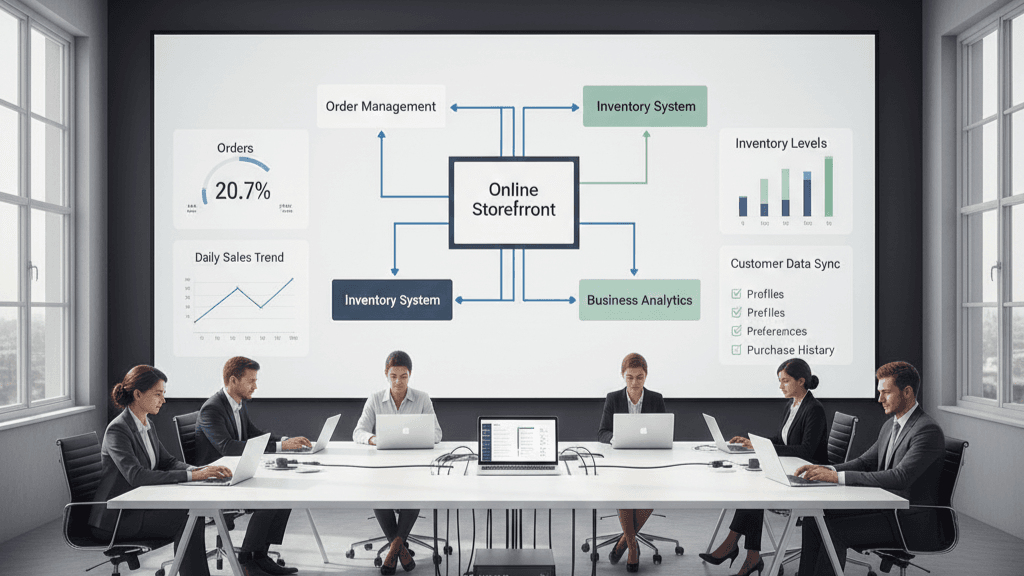
One of the prominent retail majors in the US operated multiple digital and business platforms to manage e-commerce, operations, and decision-making. However, the lack of seamless integration between these systems resulted in fragmented data flows and operational inefficiencies. To streamline processes and improve data reliability, the retailer partnered with Datayaan to design and implement an integrated solution that enabled smooth synchronization between e-commerce and business software systems.
The Challenge
The client dealt with fragmented data across multiple platforms, leading to frequent manual data entry and inconsistencies. These inefficiencies caused delays in decision-making and increased the risk of errors across operational workflows. Manual processes also placed additional strain on teams, reduced data accuracy, and had a direct impact on customer satisfaction due to slower processing times and inconsistent information across systems.
The Solution
Datayaan integrated essential connectors to enable bi-directional synchronization between the e-commerce platform and core business software. APIs were carefully mapped to ensure seamless and reliable data exchange across systems. Robust data workflows were established within the Cyclr platform to manage synchronization logic and error handling effectively.
Automation was optimized across workflows to reduce manual intervention, improve operational efficiency, and ensure consistent, real-time data availability across all connected systems.
Impact
Reduced data discrepancies by 85%
Time spent on manual tasks reduced by 25% per week
Improved data synchronization speed, saving 5 hours per week
Outcome
The retail major achieved a highly efficient and automated integration framework that significantly reduced errors, accelerated decision-making, and improved overall operational performance. With reliable real-time data synchronization, teams operated more efficiently, and customer experience improved through faster and more accurate processing.